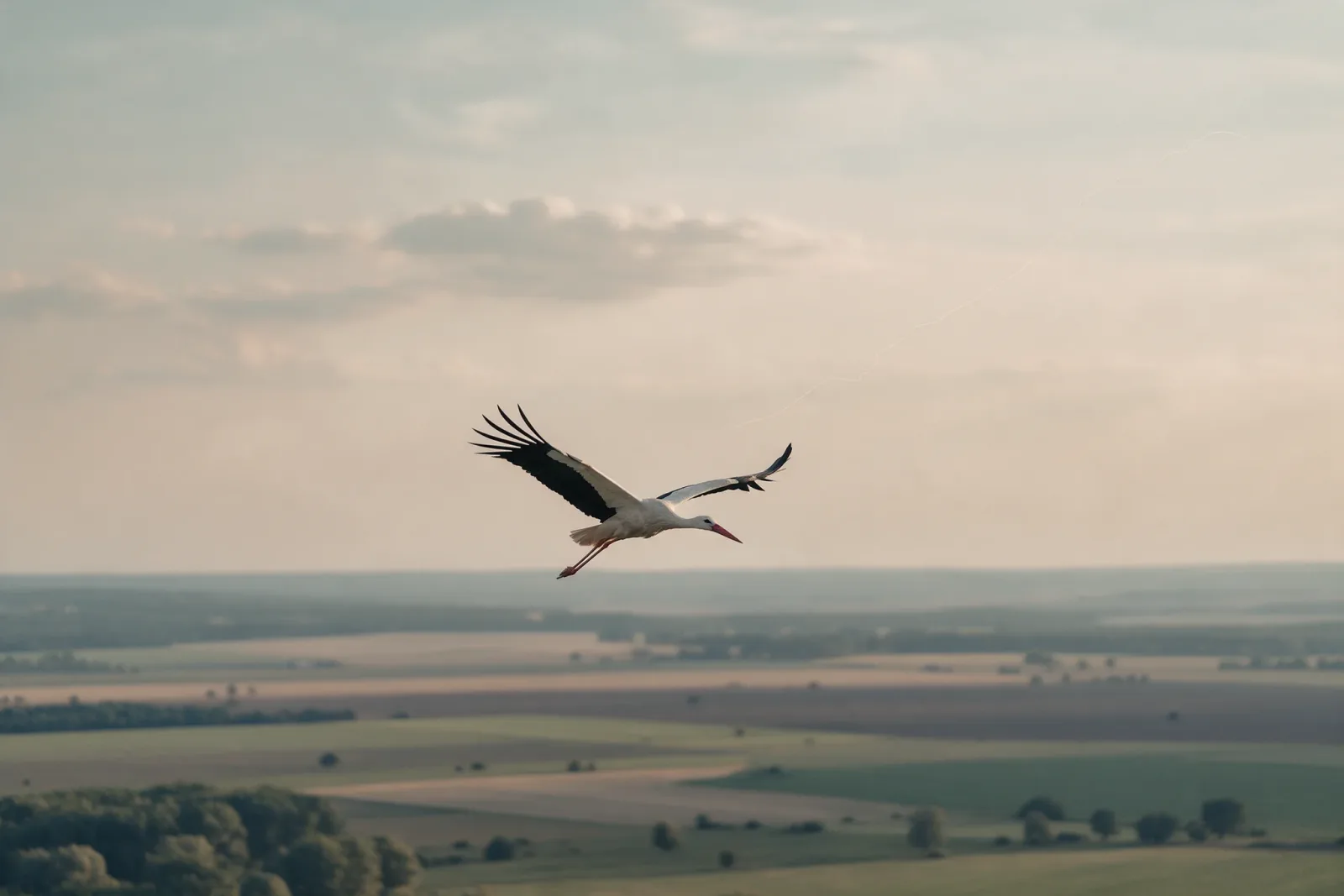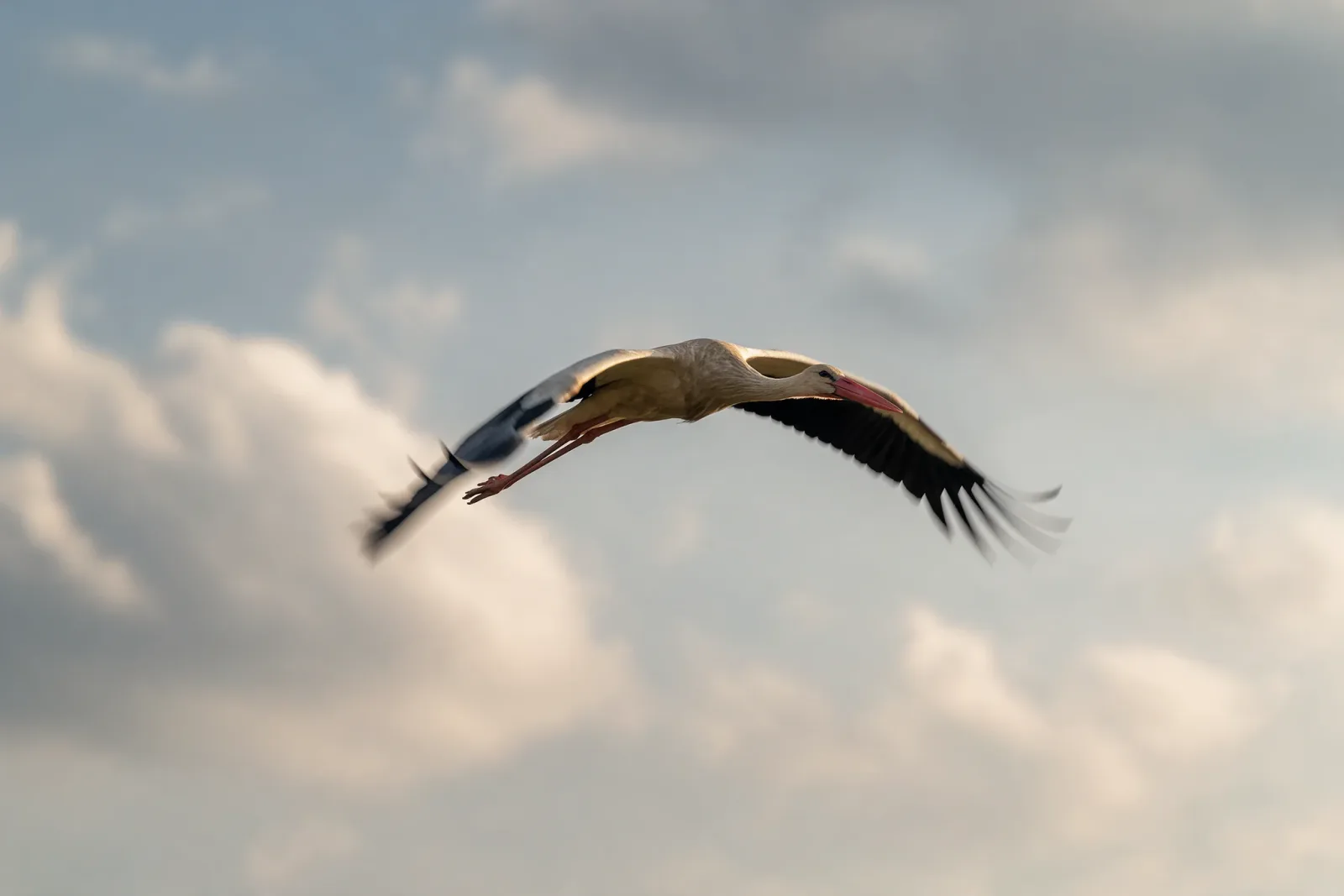
A day in the air, for a migrating stork, is a long and subtle thing, and the tracking data lets us reconstruct it hour by hour. The device on the bird's back records where it was and when, and from those points we can trace a single day's flight the way you might trace a day in a diary. The picture that emerges is not a straight line. It is a rhythm, a pattern of climbing and gliding and resting, shaped by the sun and the wind and the needs of the bird itself.
The morning launch
The day begins early, when the ground has not yet warmed enough to make good thermals, and the stork waits. Then the sun climbs, the earth heats, and the first columns of warm air begin to rise. The bird spreads its wings and launches, finding a thermal and riding it upward. The morning is the bird's great effort, the moment it gains the height that will carry it through the hours ahead.
The long glide
Once high, the stork stops climbing and begins to travel. It sets its wings and glides forward in the direction of its journey, losing height slowly, covering ground with almost no effort. The data shows this as a long, shallow descent, a bird sliding down an invisible slope of air. When it has come down too far, it finds another thermal and climbs again. The whole day is built of these two movements, climb and glide, climb and glide, repeated across the sky.
The midday pause
In the heat of the middle of the day, the stork may rest. The thermals are strong then, but the heat is also heavy, and a bird that has travelled well may pause to feed or to stand in the shade of a tree, if the land below allows. The data shows the dot nearly still for a while, a small cluster where the bird stopped. Then the journey resumes, the bird rising again on the afternoon air.
Reading the day from the data
The points from a single day are more than a line. They are a portrait of a bird's hours, and they can be read the way you would read a timetable or a tide table. The early points sit low and close together, the bird still on the ground or just rising. Then the points spread and climb, and you can see the bird catching the first thermals of the morning and turning south.
The middle of the day tells its own story. If the points stall and cluster, the bird has stopped, perhaps to feed or to rest through the heat. If they keep moving, the bird has found good air and is travelling hard. A watcher who has followed a stork for a while learns to read these patterns at a glance, and the data stops being abstract and becomes a kind of diary.
The best days are the long glides, when the points slide steadily southward for hours, the bird riding one thermal after another across the sky. Those are the days that eat up the miles, and they are what the whole migration is made of, a long string of good days strung between the nest and the winter ground.
Not every day is a flying day. Some days the weather is wrong, or the bird is tired, or the food is good where it is, and the points barely move at all. Those days matter too. They are the days the bird rebuilds itself, and the migration would fail without them. The journey is made of both, the moving days and the still ones, in a rhythm the data records faithfully.
At the end of a good day, the points come down out of the sky and settle, and the bird sleeps where the evening found it, in a field or a marsh or on a quiet roof. Twenty-four hours of flight, read from a handful of points, is a small and complete story, and tomorrow the bird will write another.
The descent into evening
As the sun lowers, the thermals weaken, and the stork's day of flying draws to a close. The bird descends for the last time, coming down toward the ground it will sleep on. It finds a field, or a wetland, or the roof of some quiet building, and lands. The data's last point of the day sits there, still, through the night. A day in the air ends the way all good days do, with the traveller safely down and resting, ready to rise and fly again at first light.
Explore the gift