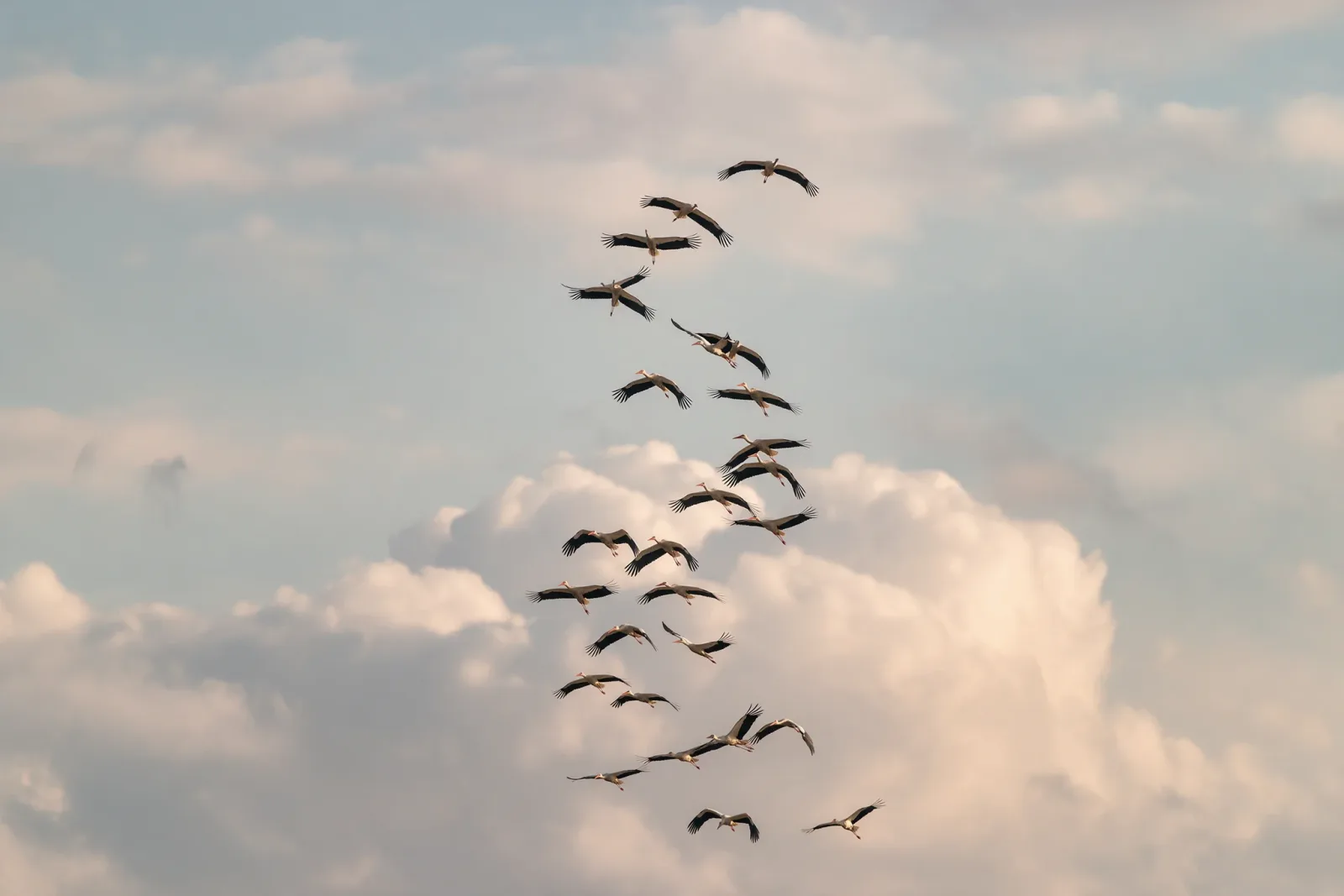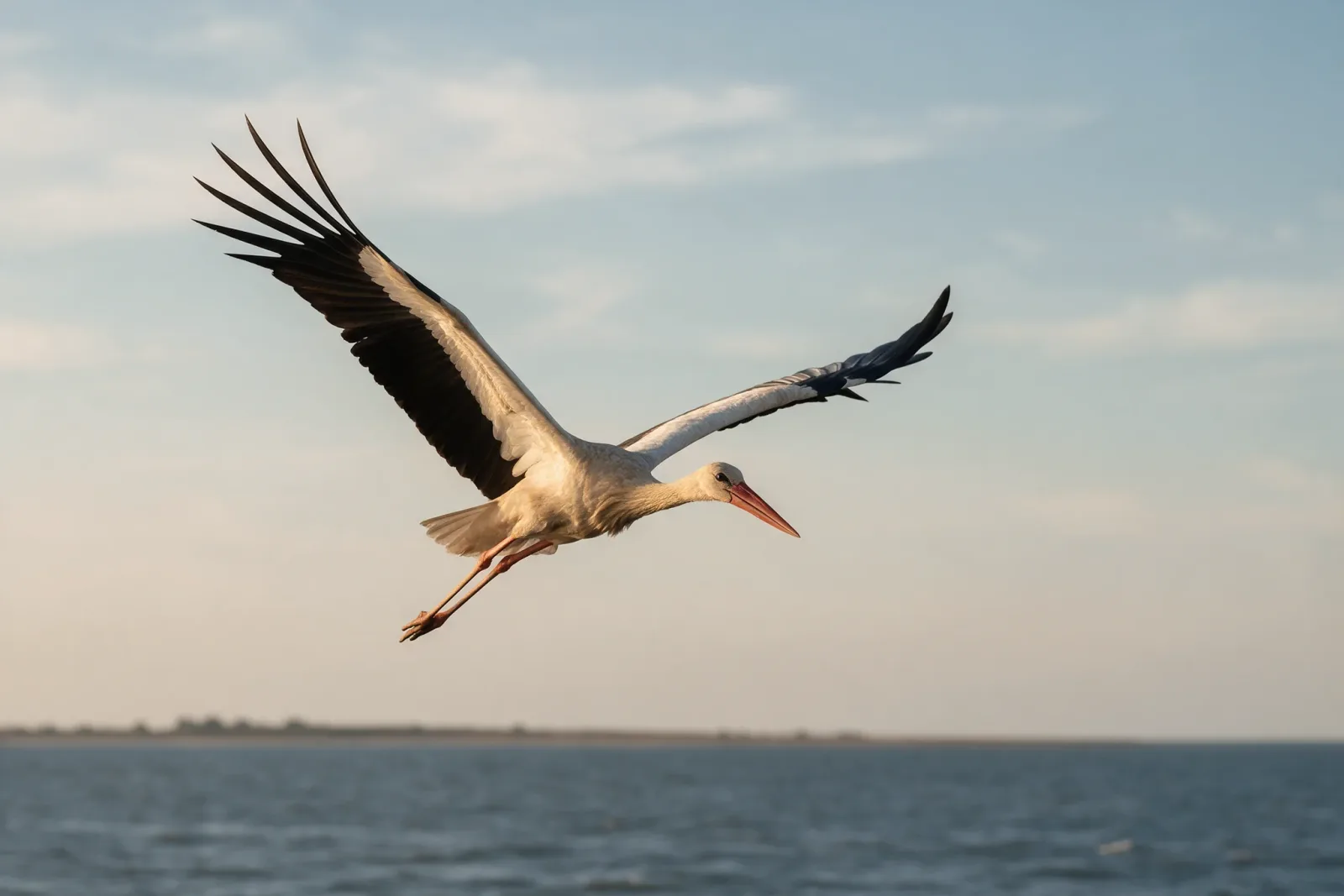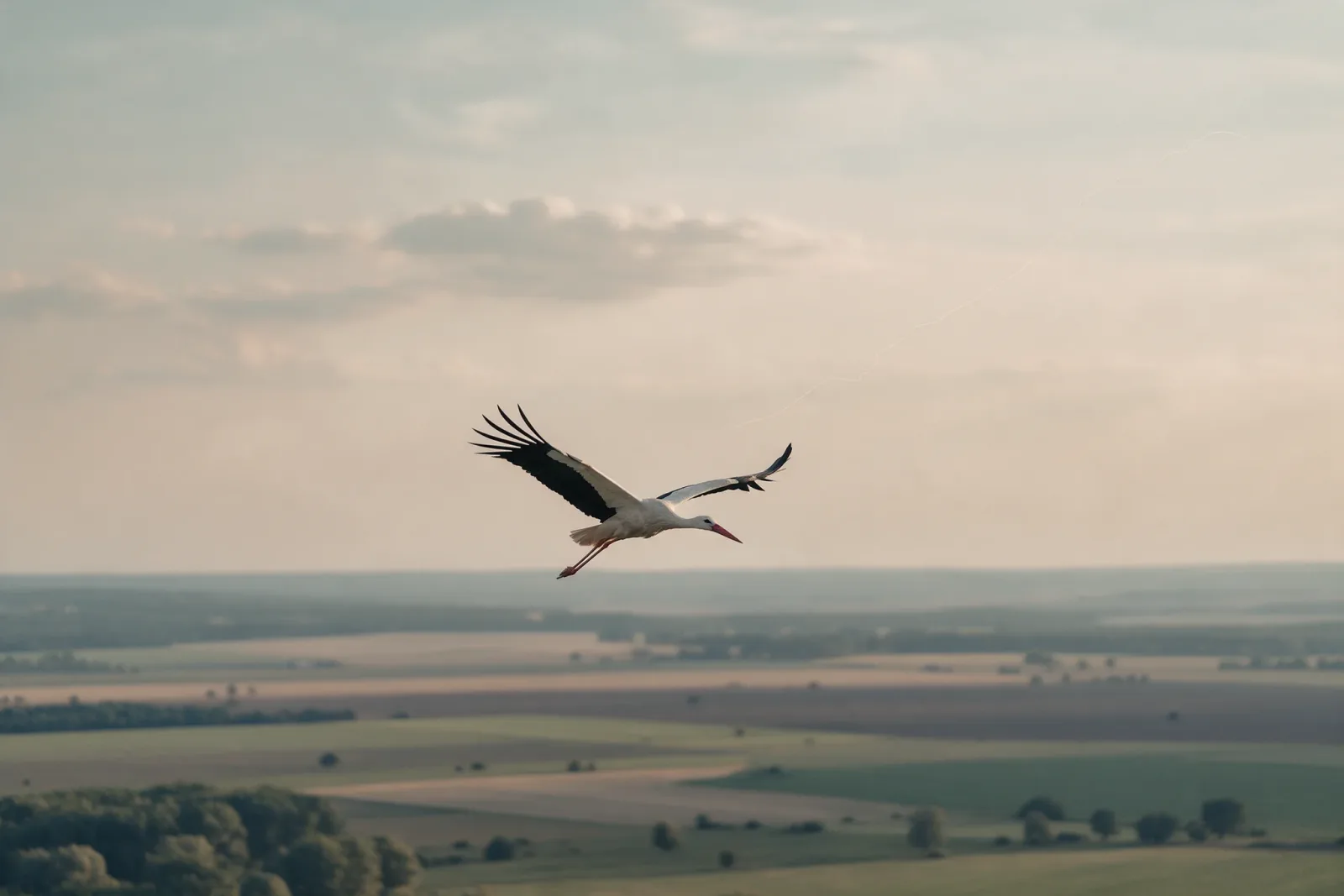
A wild story, told one signal at a time, begins with a single number. Somewhere high above the fields of Europe, a small device on a stork's back wakes, takes a reading, and sends a point home. That point becomes a dot on a map, stamped with a date and an hour. It looks like almost nothing. A coordinate, a thin line drawn between one dot and the next. But each point is a sentence, and the whole journey, read slowly over weeks, becomes a story no one else could have told you.
What a tracking point actually is
A white stork carrying a transmitter wears a small unit, usually solar powered, fitted carefully by researchers before the bird leaves the nest. The device records where the bird is and when, then transmits that information when it can. What reaches you is never the whole truth of the bird's day. It is a single snapshot, one moment in a long flight. Two points side by side can stand hours apart or minutes apart. The line the map draws between them is a guess, a straight connection over a path the stork never flew in exactly that way.
The gaps are part of the story
A wild story, told one signal at a time, also contains silence. Storks pass over places with no signal, or cloud blocks the sky, or the device saves its battery and waits. So the map has holes in it. Those holes are honest. They remind us that the bird does not belong to the map. It belongs to the sky. The quiet stretches are where the imagination works hardest, filling the empty space between one known point and the next with wind, thermals, and the long steady effort of a bird's whole body in motion.
What a signal cannot tell you
A coordinate cannot tell you what the stork saw. It cannot say whether the bird paused to drink at a river, or startled at a fox, or slept on one leg in a flooded field. It records position, not mood, not hunger, not the slow turn of the seasons. And yet, held against everything else we know, a signal can still be intimate. The dot that does not move for a week in December tells you the stork has found a place it trusts. The cluster of points over a particular valley in autumn tells you that this route, this exact line in the sky, matters enough to the bird to be returned to.

How a route takes shape
One point means little on its own. A month of points means everything. As the weeks pass, the dots begin to join into a shape, and the shape is a route. You watch the bird leave the nest, drift west, pause for a few days, move again, and slowly the whole migration opens in front of you like a map being drawn in real time. What looked like a scatter becomes a path. What looked like chance becomes a pattern. The bird is not wandering. It is travelling, and each signal is a quiet line in the record of that travel.
Over a whole season the shape of the journey tells you more than any single dot ever could. You begin to see where the bird rests, where it hurries, where it lingers. The route bends around seas, pauses at good feeding grounds, waits out bad weather. Reading it is like reading a handwriting, a signature the bird leaves across half the world, one signal at a time, and it belongs to anyone patient enough to watch it form.
Reading slowly
The pleasure of a tracked migration is the pleasure of reading slowly. You do not watch the dots race. You let them accumulate. One morning the bird is here, the next week it is somewhere you had to look up on a map, a name you had never said aloud before. A wild story, told one signal at a time, asks for patience, and it rewards it. The ending is never promised, and that is the point of it. You are not following a plot. You are following a life, one signal at a time, from the nest where it began to the far field where it will rest.
Explore the gift