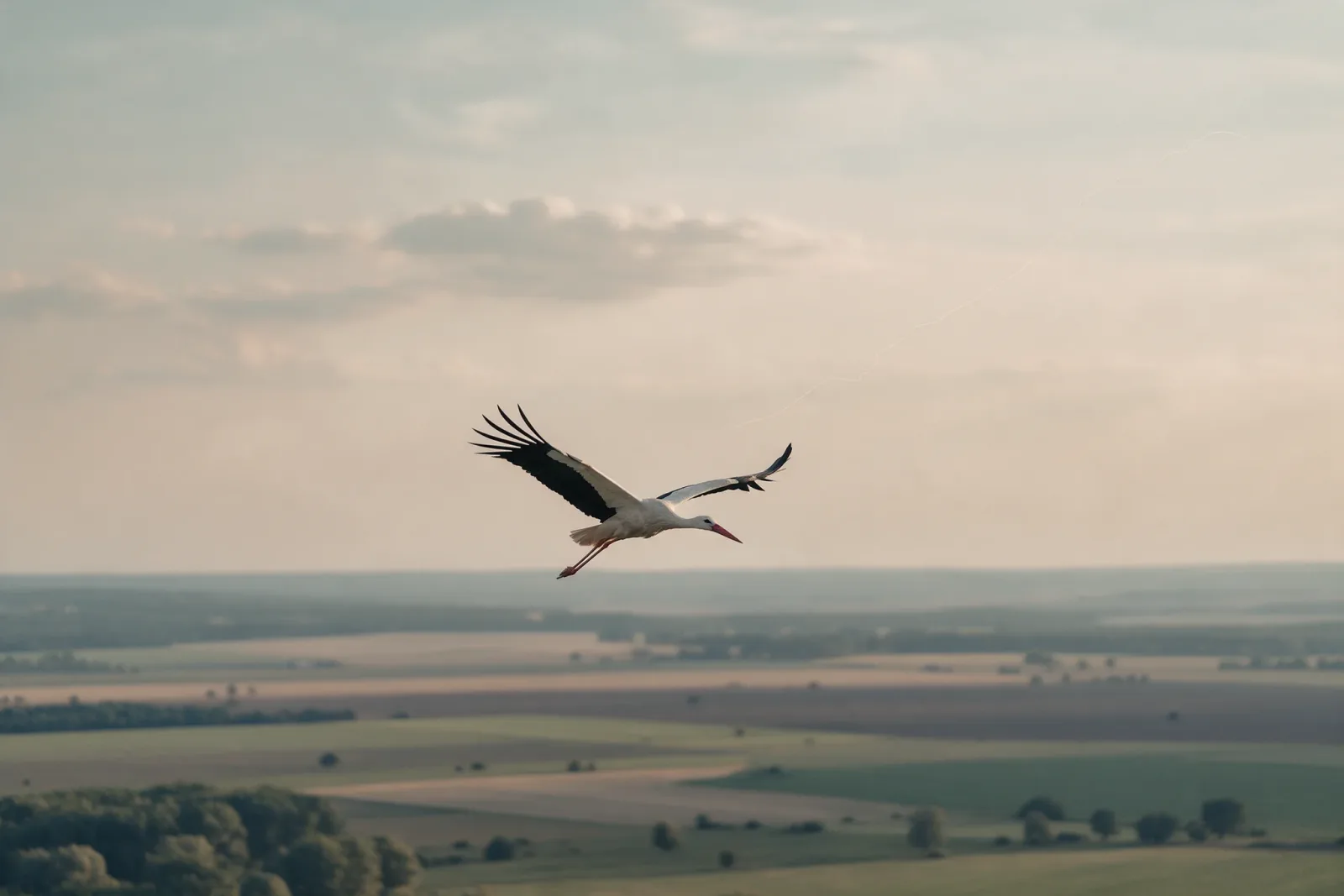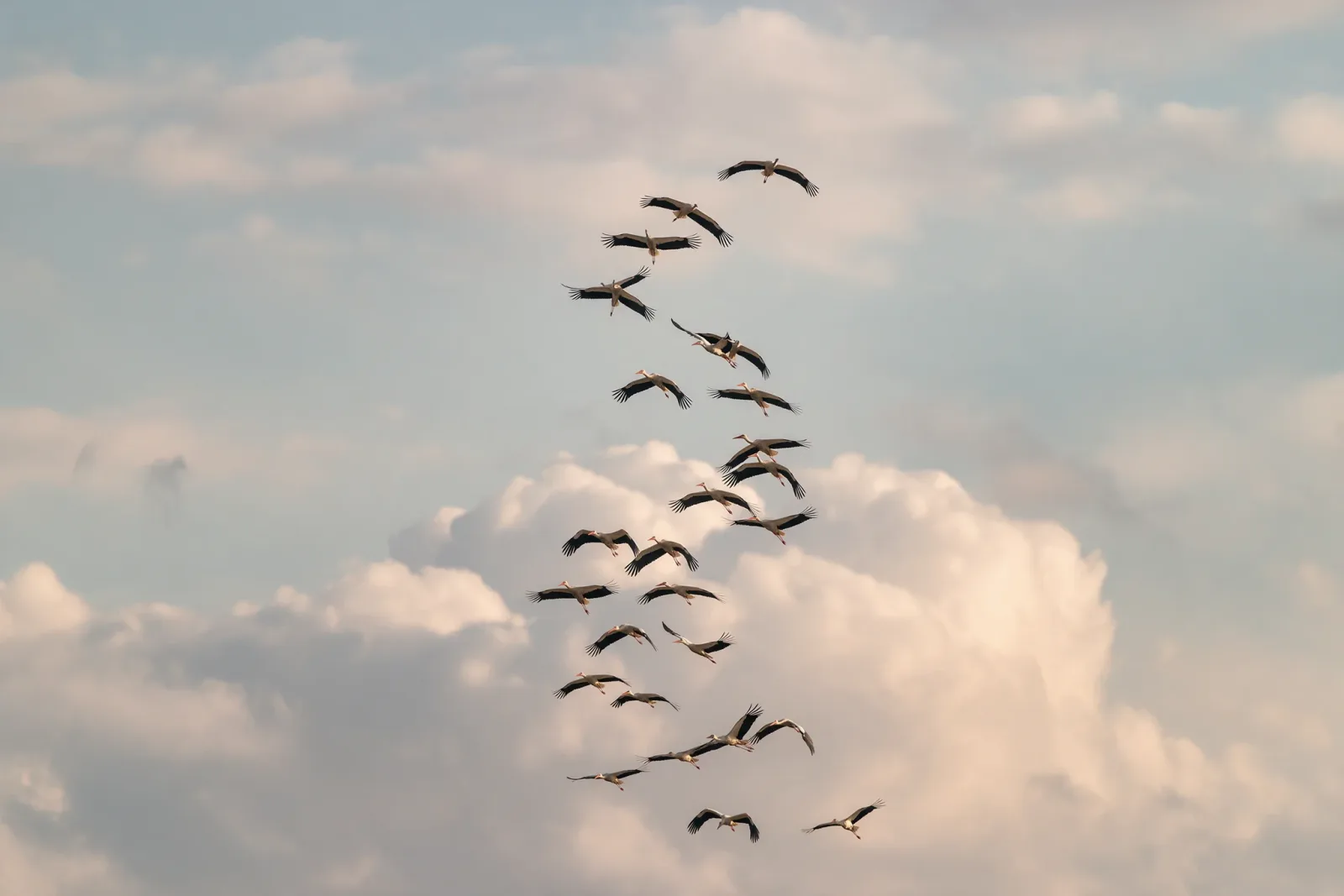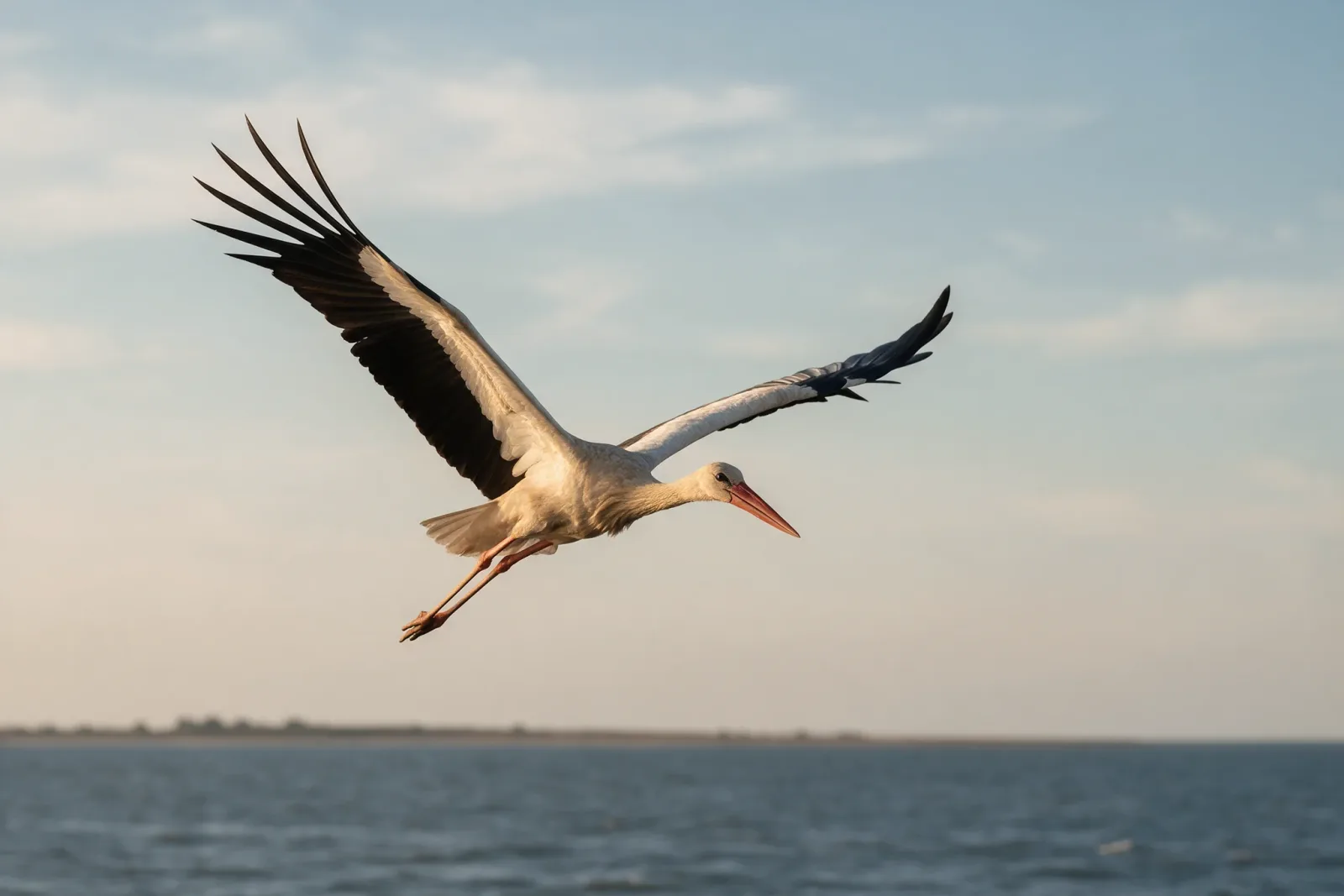
How far can a stork fly? Farther than most of us would guess, and farther than seems reasonable for a bird that spends so much of its day standing in wet grass. A white stork does not look like a long-distance traveller. It walks through meadows on long legs, it rests for hours on a chimney, it moves slowly and deliberately on the ground. And yet, in a single year, that same bird can cover a distance that would carry it from one end of a continent to the other and back again.
A year measured in air
A white stork travels between its breeding grounds in Europe and its wintering grounds in sub-Saharan Africa. The route south and the route north together add up to thousands of kilometres, and that is before you count the daily movement, the searching for food, the circling on thermals, the slow drift from one feeding ground to the next. A tracked stork's map, at the end of a year, is not a single line. It is a dense web of travel, most of it in the air.
The long way and the short way
Not every stork flies the same distance. A bird from western Europe may cross at Gibraltar and travel a route of one length. A bird from farther east may cross the Bosphorus and travel another. Some storks winter in North Africa and travel a shorter course. Others push deep into the southern continent and travel much farther. How far can a stork fly? The honest answer is that it depends on the bird, the route, and the year. Some journeys are modest. Some are astonishing.
How they manage it
The secret to such distance is that a stork barely flaps. It soars. It rises on warm thermals, glides down to the next one, and lets the air do most of the work. A stork in migration can travel for hours while spending very little energy, resting on the wind the way a boat rests on a current. This is what makes the long journey possible. The bird does not power itself across the continent. It is carried, in stages, by the warm rising air of a thousand sunlit afternoons.
What the tracked birds show
The tracked storks of the LifeTrack White Stork SW Germany study have made these distances real. A bird that seems to belong to one village, one rooftop, one stretch of meadow, turns out to be a bird that crosses half the planet each year. The transmitter does not exaggerate. It simply records, point by point, the full scale of a life we used to imagine was small. The map fills in, and the ordinary stork becomes extraordinary.
Following one of these birds through a single year is a lesson in scale. The distance it covers would take a person months of steady walking, and the bird does it on wings that weigh almost nothing, propelled mostly by the sun-warmed air. How far can a stork fly? The tracked birds answer the question in miles, but the miles never quite capture it.
Two storks from nests only a few fields apart may winter on different continents, one in the northern green, one far in the south. Distance is not fate. It is a set of choices made by wind, weather, and the bird itself, repeated differently each autumn. That is part of the wonder, that no two storks travel exactly the same world.
A stork in migration is never in a hurry. It climbs when the air allows, glides when the air permits, and waits when the air refuses. The long distance is made of many small, calm decisions, and the bird makes them with a patience that seems to have all the time in the world.
The number that matters less
People want a number, and the number is large, but the number is not really the point. The point is the fact of it, that a bird you might watch standing in a meadow outside your window has crossed a sea and a desert and returned to that same meadow, all within one turning of the year. How far can a stork fly? Far enough to make the whole world feel like home.
Explore the gift