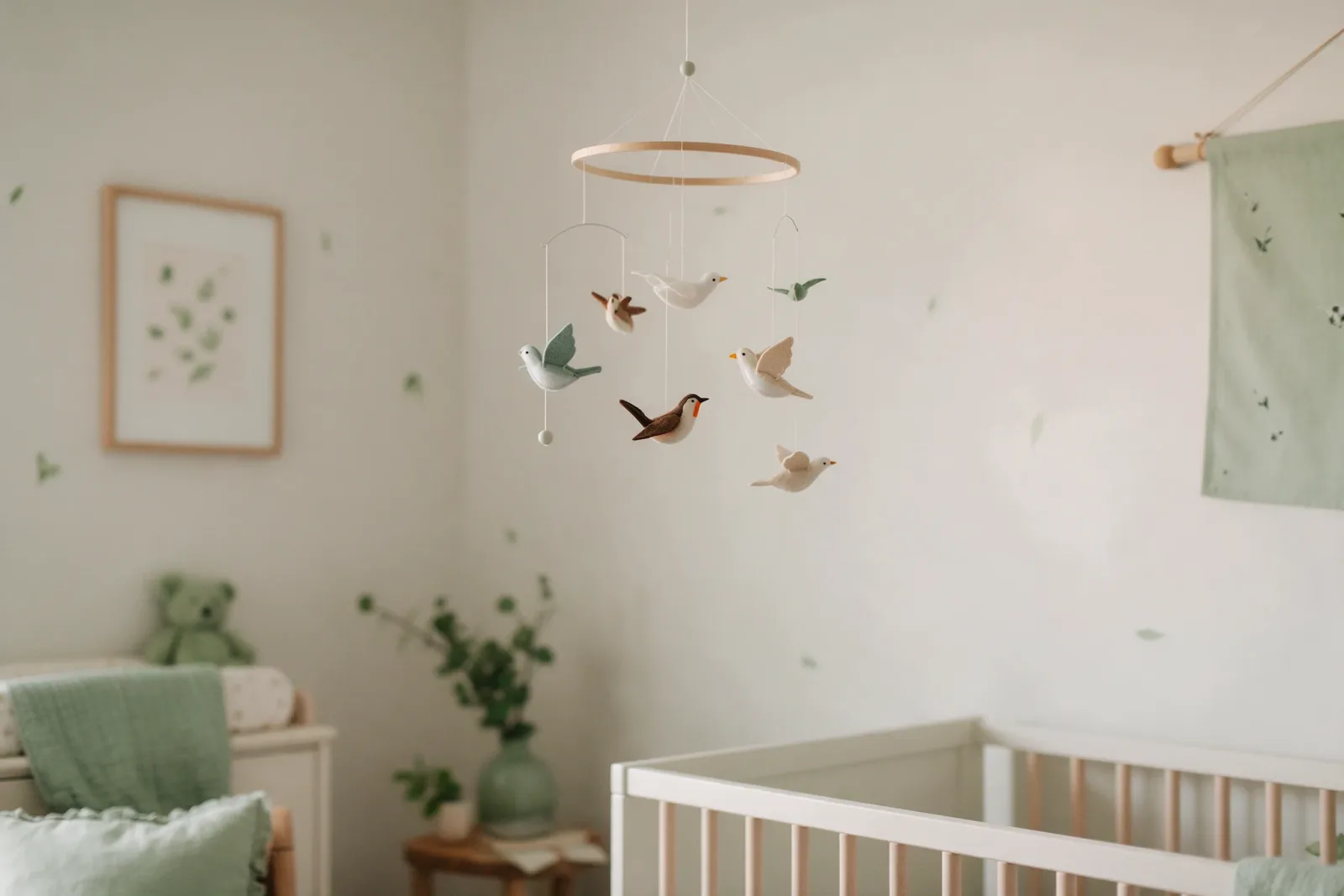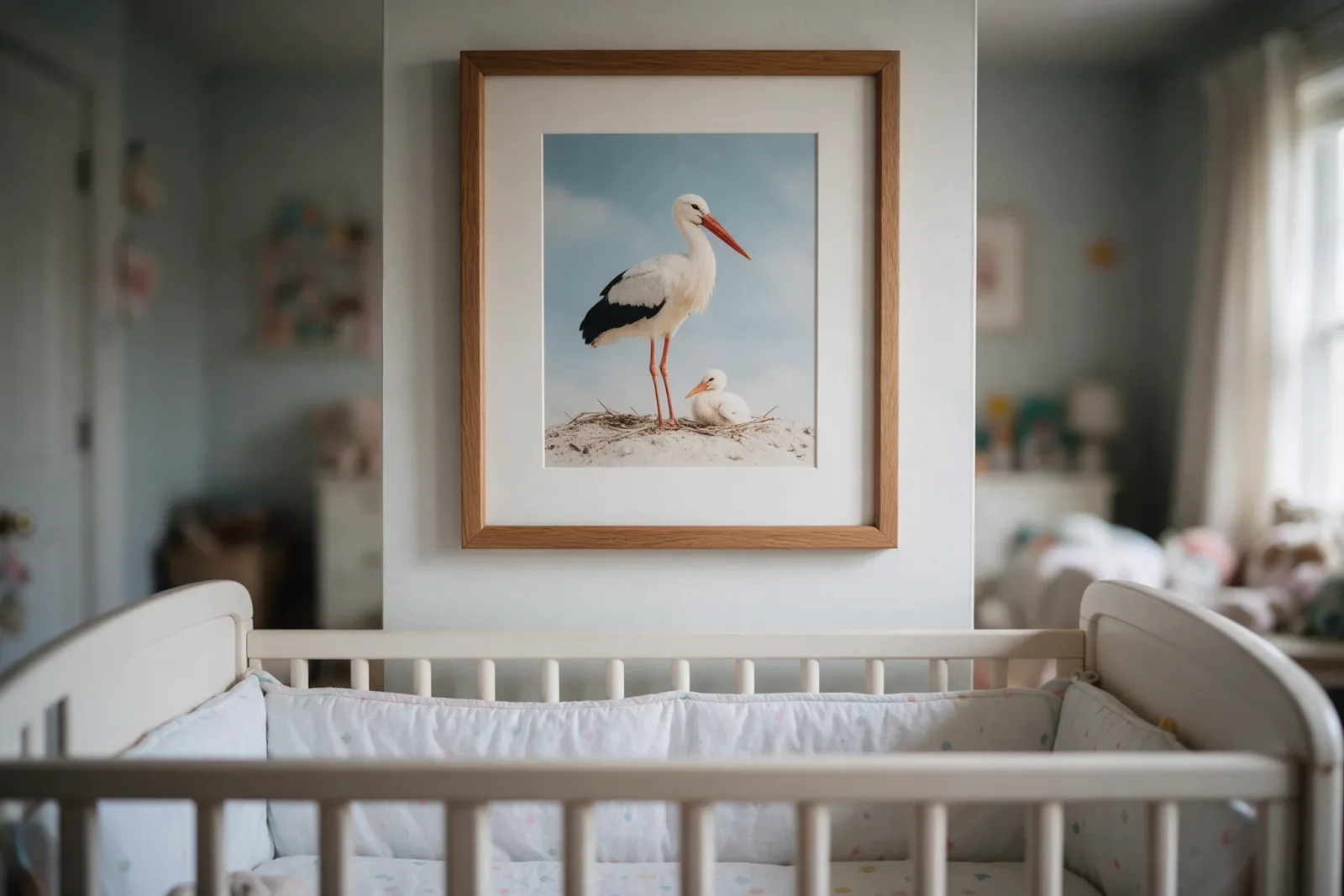
Every nursery has a quiet corner, and every quiet corner wants a friend. A friend for the nursery does not need to move or make a sound. It only needs to be there, steady and familiar, so that the baby has something gentle to look at in the long hours of lying still. A picture of a stork above the crib can be exactly that.
Children form attachments to what they see again and again. The same shape in the same place, day after day, becomes part of the furniture of a child's world. A stork on the wall, white and long-legged against a soft sky, gives a baby a first landmark, a thing that is always there when they wake.
The right kind of picture
What you hang matters less than how it feels. Soft colours, simple lines, nothing loud or busy. A stork standing in a meadow, or flying across a pale sky, or standing on one leg by water. The picture should feel calm, the way the room should feel calm. A baby's first art should soothe, not compete for attention.
There is no need for anything elaborate. A simple print, a drawing, even a single small framed card will do. The friend does not have to be perfect. It only has to be there, and to stay.
The bird becomes a presence
Over time the picture stops being decoration and becomes a presence. The baby will stare at it during feeds, will find it again after every nap, will one day reach toward it and babble. You will find yourself talking about it too. Look, there is our stork. The word becomes one of the first soft sounds the child connects to a real thing.
A friend who has its own life
The loveliest part of a stork friend is that it points beyond the wall. Out in the world there are real storks, living their own long lives, flying south each autumn and north each spring. The bird on the wall is not just a shape. It is a doorway, and one day the child will be old enough to walk through it.
Hang it where the light finds it
Put the picture where the morning light touches it, and it will change through the day the way the sky changes. In the evening it will soften and fade, and by then the baby will likely be asleep. A friend for the nursery is at its best in the quiet hours, keeping watch while the room breathes.
A friend for the nursery does not have to be a stork, though a stork is a fine choice. Any gentle bird will do, any quiet shape a child can learn by heart. What matters is that it stays. The friend's first job is constancy, and it performs that job simply by not moving, by being there every single morning.
There is something quietly powerful in a picture of a creature that spends its life in the open air. Long before a child can go out and meet the world, the friend on the wall is a kind of ambassador for it, a promise that beyond this room there are fields and skies and birds that fly.
Do not be surprised if the child eventually names the friend, or talks to it, or insists it be included in bedtime stories. These are good signs. They mean the friend has crossed over from decoration to companion, and the nursery has gained a quiet soul.
The friend asks nothing of the family and takes up no space in the day. It simply waits, the way a good friend waits, and lets the baby come to it in its own time. That is the gentlest kind of company there is: a presence that does not demand, only stays.
The friend will watch over the room long after the baby has outgrown the cot. In time it may move to a shelf, then a school bag, then a drawer of keepsakes. But it will always be the first quiet thing the child ever looked at, and that gives it a place nothing else can take.
You do not need to explain any of this to the baby. The baby is learning it without words, the way a nestling learns the shape of its parent against the sky. One day the child will point at the picture and say the name, and you will understand that the friend has been doing its quiet work all along.
Explore the gift