A nursery that feels like sky is less about decoration than it is about light. A baby in the first weeks spends most of its time indoors, lying on its back, looking up at a ceiling. What you put above and around the crib becomes the child's first landscape. You do not need much to bring the outside in. You need pale walls, soft colour, and a little patience.
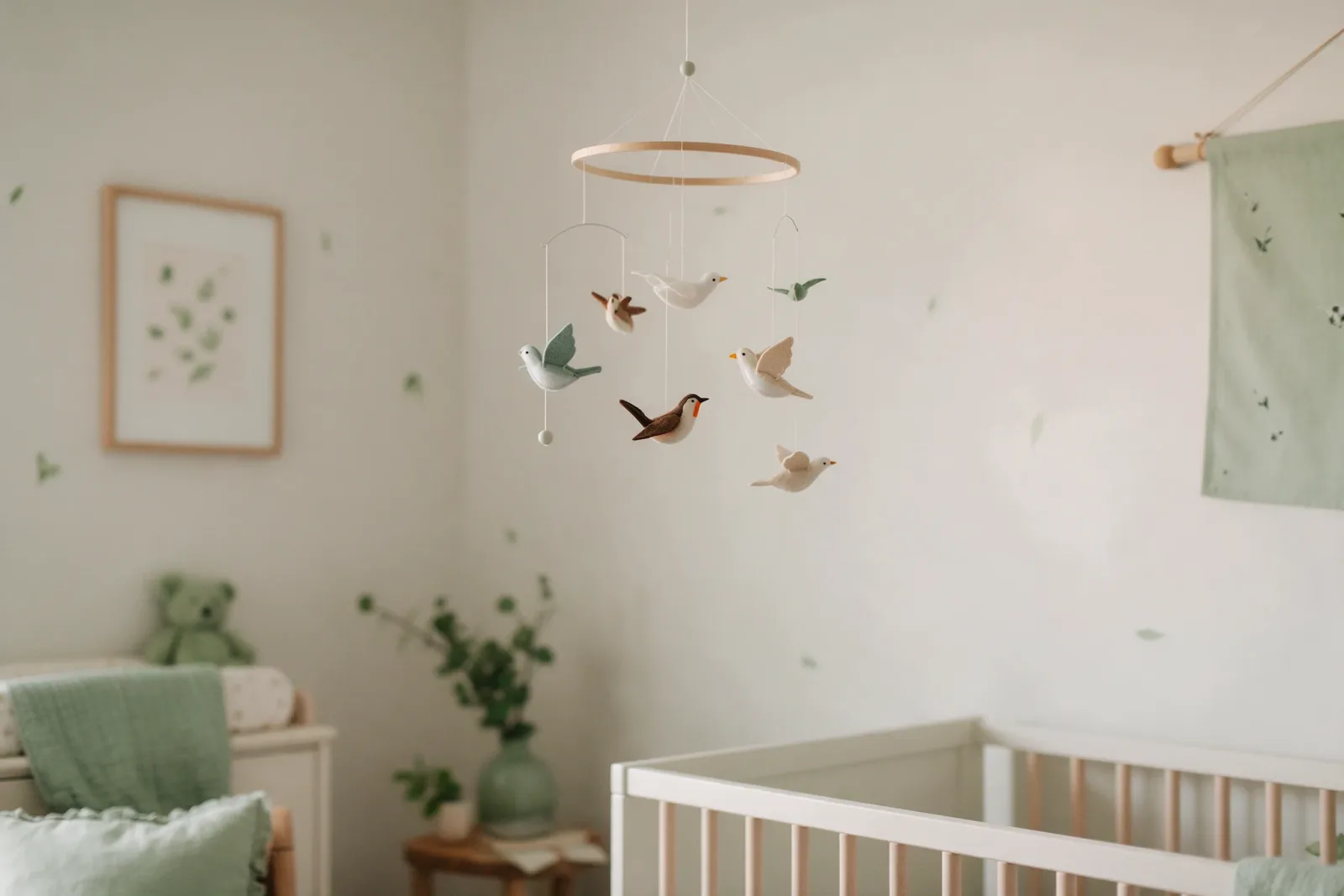
Newborns see the world in soft focus. High contrast and gentle shapes register first, which is why a simple bird mobile turning slowly above a cot is such a fine companion. It moves without being rushed, the way clouds move, the way a stork drifts overhead without seeming to hurry.
Start with light
Before you hang anything, look at the room's light. Morning light on a pale wall is the cheapest and loveliest thing you can give a baby. Thin curtains that let the sun through in a warm wash turn a plain room into a place that changes all day. A nursery that feels like sky is one where the light is allowed to move across the walls the way it moves across a meadow.
Light is also a kind of clock. As the day turns, the room shifts from bright to gold to dim, and the baby, without any help from you, begins to learn the shape of a day. That slow lesson, taught by a window, is worth more than any wall decal.
The colour of open air
Pale blues, soft greens, and warm off-whites all recall the outdoors without shouting about it. A wash of the palest blue on one wall can read as sky, especially in the low light of an afternoon nap. Keep the rest of the room calm so that the one wall does the work. A nursery should feel like a slow breath, not a display.
Do not worry about getting the colour exactly right. A child will not remember whether the blue was periwinkle or powder. What the child will absorb is the general calm of the room, the way a nestling absorbs the calm of a nest without cataloguing its twigs.
A bird to watch over the crib
Above the cot, one bird is enough. A single wooden or paper stork, painted simply, gives a baby something steady to look at while the rest of the room stays still. Children do not need a flock. They need one shape they can learn by heart, the way a nestling learns the silhouette of its parent returning to the roof.
Grow the room slowly
You can let the room change as the baby does. A window feeder that brings real birds close, a small potted plant on the sill, a picture of a stork in flight. Each addition is small, and each one gives the child a reason to look up. A nursery that feels like sky is not finished all at once. It gathers, the way a nest gathers, twig by twig, until it holds.
Sound matters in a sky room too. A gentle wind chime, a mobile that turns without a motor, the soft rattle of rain on the window. A baby cannot go out to hear the wind, so bring a little of it in. The goal is a room that feels alive but never loud, the way a meadow hums without ever shouting.
Resist the urge to finish the room before the baby arrives. A nursery is a living thing, and it will tell you what it needs as the baby grows. The best rooms are assembled slowly, one small, loved object at a time, so that every corner holds a memory instead of a receipt.
There is no single right way to build such a room, and no wrong one either. The only real test is whether it feels calm to you. If the room settles you when you walk in, it will settle the baby too. Trust that. The child is not judging the design. The child is learning the feeling of the place, and a calm parent in a calm room is the whole lesson.
By the time the baby is old enough to point and babble, the room will already be telling a story: there is a sky, there are birds in it, and you are part of a world that is bigger than this room. That is a good first lesson for anyone.
Explore the gift