Growing up in a nest is a short, intense season in which a stork transforms almost beyond recognition. A white stork chick is born nearly naked, a blind and wobbling thing, and within two months it becomes a bird built for flight. Those weeks in the nest are among the fastest growth any creature knows.
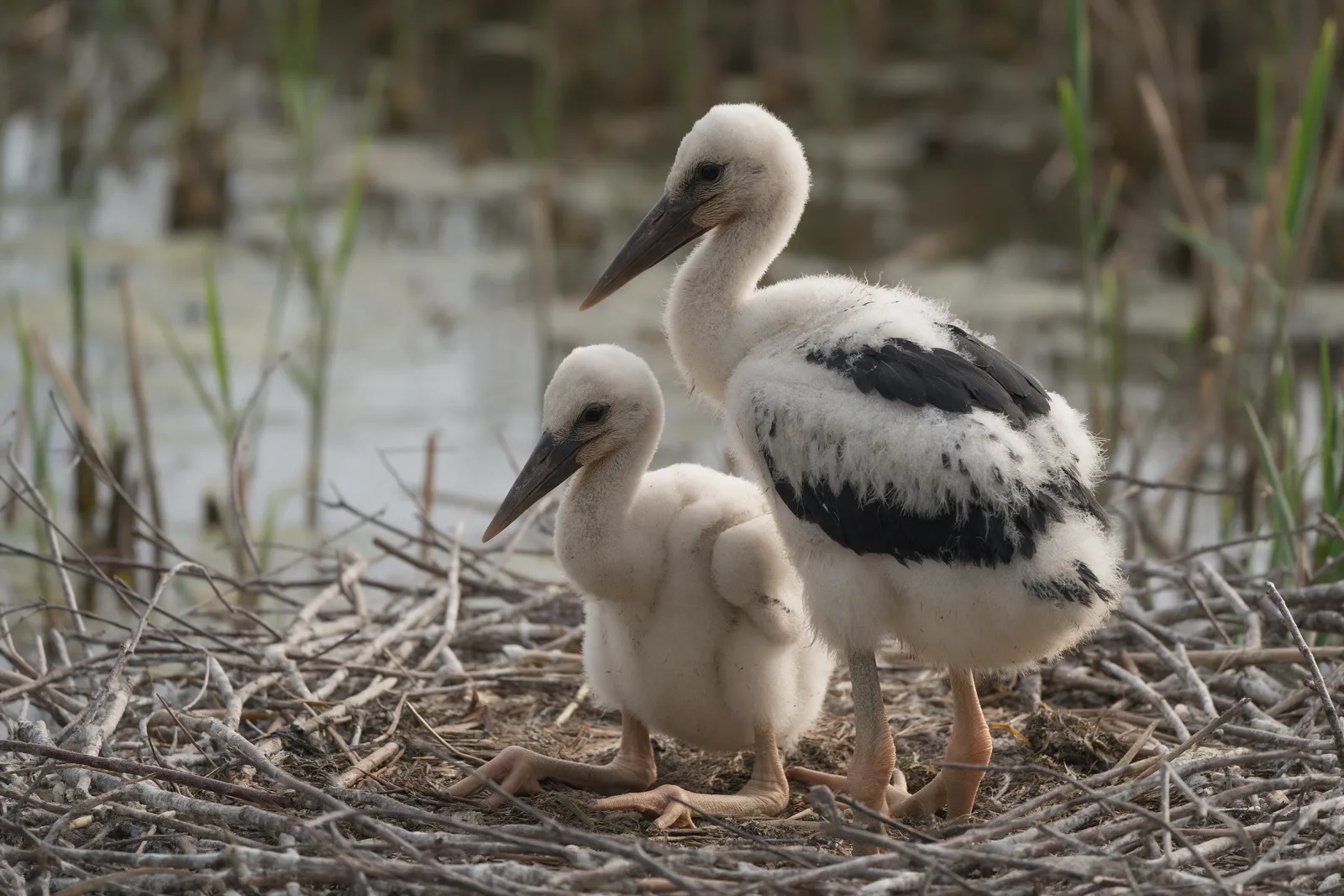
The change happens so steadily that a watcher can almost see it day by day. The down thickens, then gives way to true feathers. The legs lengthen. The bill, soft at first, hardens and darkens. By the time the chicks are a month old, they look like thin, ungainly versions of their parents.
From fluff to feathers
The first covering is a fine grey down, warm but useless for flying. Beneath it the real feathers are already pushing through, first as dark quills and then as the familiar white and black of the adult bird. The tail feathers come, and the long flight feathers of the wing, each one needing blood and food to grow.
Feathers are expensive. A growing chick eats an enormous amount, and the parents spend their days shuttling food to the nest. Every meal becomes feather and bone and muscle, a small body being assembled in plain sight.
Standing on the edge
As the legs strengthen, the chicks begin to stand. At first they brace themselves against the sides of the nest, wings half open for balance. Then they climb the rim and stand there, swaying in the wind, looking out at the rooftops and the fields beyond.
This is the moment a chick begins to see the world it will soon enter. It watches other birds in the sky, watches its parents come and go, and exercises the wings it will one day trust with its life.
The nest as a small kingdom
The nest is the chicks' whole world for those weeks. It is home and table and nursery and lookout, a platform of sticks woven and re-woven by generations of parents. Within its rim the chicks squabble, sleep, and preen, learning the small social codes of stork life.
They watch everything. A chick learns to beg for food, to keep out of the way when a parent lands heavily, to read the sky for the signs of weather. Much of what a stork knows is not taught but absorbed, in the long still hours between meals.
The long apprenticeship
By the seventh or eighth week the chicks are nearly grown, and the nest begins to feel small. They exercise their wings in earnest, leaping and flapping, lifting a little off the platform and settling back down. The parents feed them less, and the young begin to feel the pull of the sky.
Growing up in a nest is, in the end, a preparation for leaving it. Every feather and every flap is practice for the single day when the bird steps off the rim and the air, at last, takes its weight.
Explore the gift