The first walk outside is a small expedition disguised as an ordinary errand. You wrap the baby, find the keys, open the door, and step into a world that has been carrying on without you. The baby, who has known only rooms for weeks, meets the open sky for the first time in a single, enormous blink.
Newborns cannot see far, but they can feel the change. The air moves on their skin. The light is suddenly huge and unbroken. A leaf turns, a dog barks somewhere, a shadow slides over the pram. The whole world arrives at once, and the baby takes it in without knowing what any of it is.
The sky is the first big thing
Every baby's first real landscape is the sky. It is the largest thing a child will ever look at, and it is always there, waiting. On the first walk outside, tilt the pram hood back a little and let the baby lie beneath the blue. There is nothing to explain and nothing to do. The sky teaches itself.
A bird crosses the frame
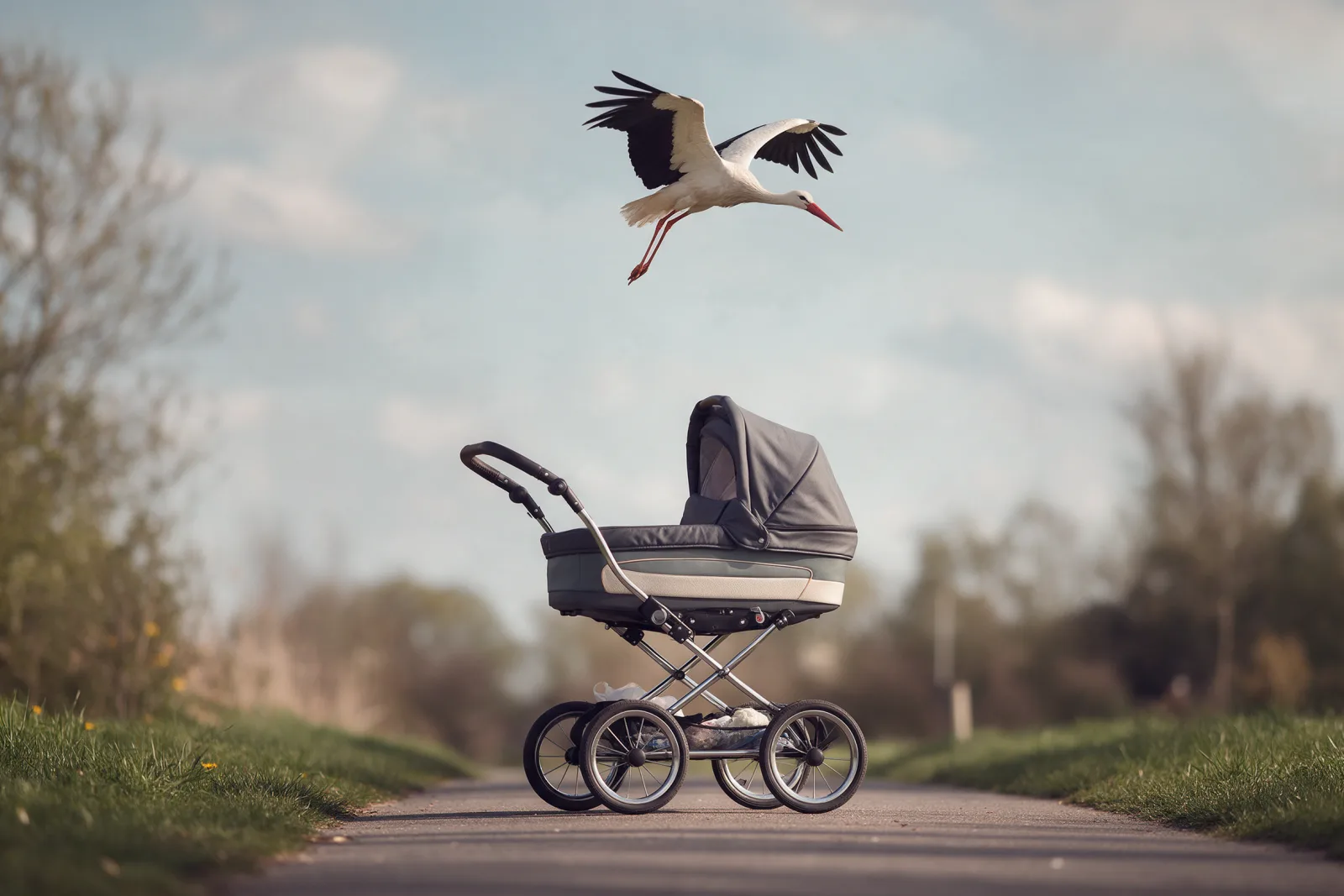
Sooner or later, something passes across that blue. A gull, a pigeon, a crow, or if the season and the place are right, a white stork, high and slow, riding the air without a single flap. A baby does not know a stork from a sparrow, but it notices movement against stillness, and that noticing is the beginning of wonder.
You can point and say the word bird, and even if the baby cannot repeat it, the pairing of sound and sight has begun. This is how the world gets its names, one small moment at a time.
Let the walk be slow
There is no need to hurry the first walk. Five minutes is a full journey for a baby whose world has been a bassinet. Let the child doze, let the wheels rattle, let the day go on around you both. The point is not distance. The point is that the baby learns, in a small and wordless way, that home is not the whole world.
The bird that crossed the sky
Months later, when a named stork's journey appears on a map in your home, the connection will have already begun. The child will have seen a bird cross a real sky and will know, in its bones, that such a thing is possible. A map is just a promise. The first walk outside is where the promise first came true.
The pram hood, the blanket, the strap that never sits quite right: these are the small equipment of a first walk, and they matter far less than the moment itself. Do not wait for perfect weather or perfect timing. A cool grey morning is as good a teacher as a bright one. The world does its explaining in every kind of light.
There is a particular stillness to that first walk, a sense that you have crossed some small threshold as a family. You left the house as you have left it a thousand times, and yet you returned different, because now the baby has known the sky, and the sky has known the baby.
Years later you may pass the same corner and remember that first walk, the weight of the pram, the uncertainty of it. The corner will not have changed. The child will have. That is the quiet work of a first walk: it plants a beginning so small you do not see it growing.
There will be many walks after this one, thousands of them, most forgotten. But this first one stays. It is the walk where the outside stopped being an idea and became a place, where the sky stopped being a picture and became something the baby had actually lain under. You were there for that. It is not a small thing.
You do not need a destination. The walk is the whole of it, and the baby does not care how far you go or where you end up. The only thing that matters is the door, the air, the sky, and the two of you out in it. Everything else can wait.
You will not remember every detail of that walk, but the baby will keep it somewhere, folded into the memory of light and air. One day the child will run ahead of you on a path, and you will think back to the first small step out the door, when the whole sky was waiting to be met.
Explore the gift