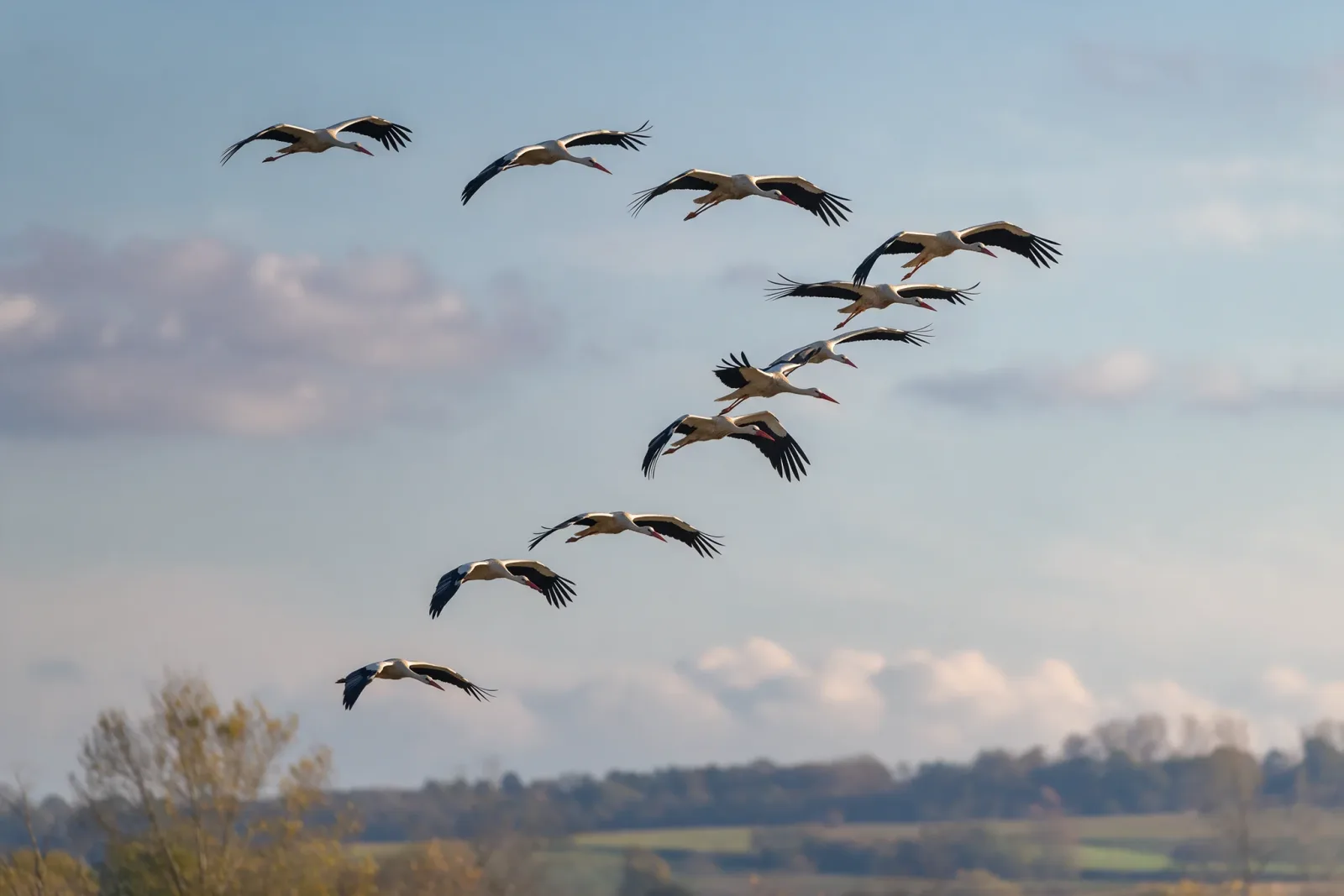
The southbound sky is one of the great sights of the year, and it asks only that you look up at the right moment. A flock of storks, strung out in a loose line, heading south across a fading afternoon, is the season writing its own direction across the heavens. To read that sky is to read the turning of the year itself, the slow, certain tilt of everything toward the south and the winter.
How to read a flock
A flock heading south is not hard to read once you know what to look for. The birds fly in a rough line or a shallow V, and they hold a steady direction, not circling or doubling back. They are high, most of the time, riding the thermals that carry them south with little effort, and they move with a purpose that is easy to feel even from the ground. A feeding flock wanders and settles; a migrating flock flows, and keeps flowing.
What the direction says
The direction of a flock says more than the birds themselves. A line of storks moving south says that the season has turned, that the days have shortened, that the warm air will soon fail in the north. It says that the breeding year is over and the long journey has begun. To watch a southbound flock is to hear the year announce, without words, that autumn has arrived and winter is not far behind. The sky itself seems to lean south with them.
The afternoon of departure
The southbound sky is at its best in the late afternoon, when the light begins to soften and the day's last thermals are still strong. It is then that the flocks rise and turn south, and the whole sky seems to empty itself in that direction. There is a stillness to the moment, a sense of watching something old and unchangeable, the birds following a route their ancestors followed, the direction as fixed as the stars.
The comfort of the south
There is a comfort in the southbound sky, for all the melancholy of its meaning. The birds are not fleeing the north; they are going toward something, toward warmth and food and the long rest of winter. The direction they fly is a direction of hope, and the people who watch them know it. The southbound sky is not an ending. It is a promise of return, a guarantee, written in wings, that the north will not be empty forever.
Marking the moment
So mark the moment when you see it. There will be an afternoon this autumn, perhaps when you least expect it, when a line of storks crosses the sky above you, heading south. Stop and watch it. Let the birds pass, and feel the year turn beneath them. You are standing in a small piece of something enormous, the great southward movement of a whole season. And the sky, for a few minutes, belongs entirely to the birds.
Explore the gift